
Mallet Finger vs Jersey Finger
Compare mallet finger and jersey finger injuries, including extensor vs flexor tendon anatomy, X-ray findings, MRI clues, and treatment urgency.
Key Takeaways
- Mallet finger is an extension problem; jersey finger is a flexion problem
- Jersey finger can be time-sensitive because the flexor tendon may retract
- Normal X-rays do not exclude a tendon-only injury
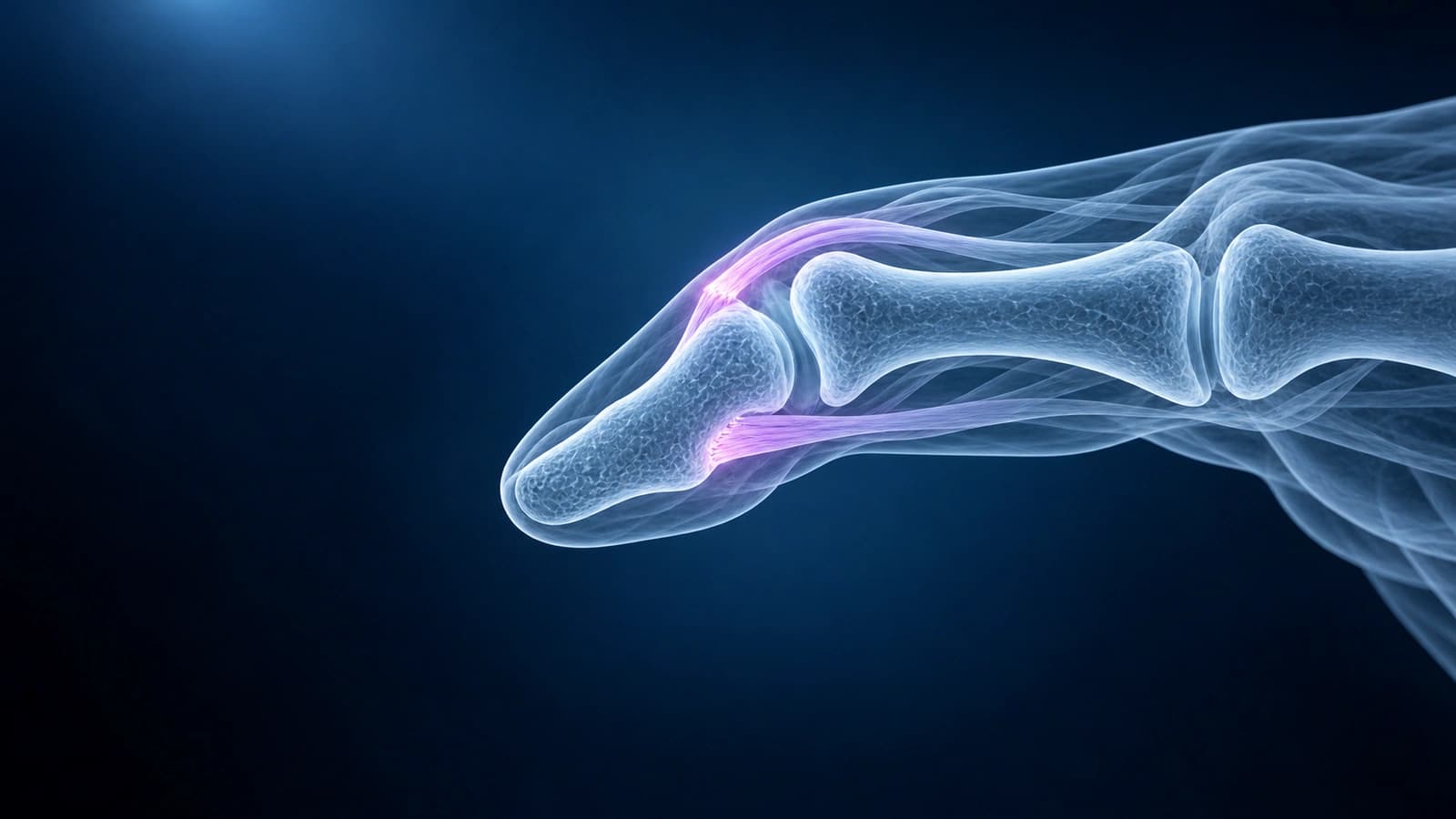
Mallet finger and jersey finger both affect the fingertip, but they are opposite tendon problems. Mallet finger affects active extension. Jersey finger affects active flexion.
The Fast Difference
- Mallet finger: the fingertip droops and cannot actively straighten
- Jersey finger: the fingertip cannot actively bend
- Mallet injury is on the extensor side near the back of the DIP joint
- Jersey injury is on the flexor side where the FDP tendon inserts
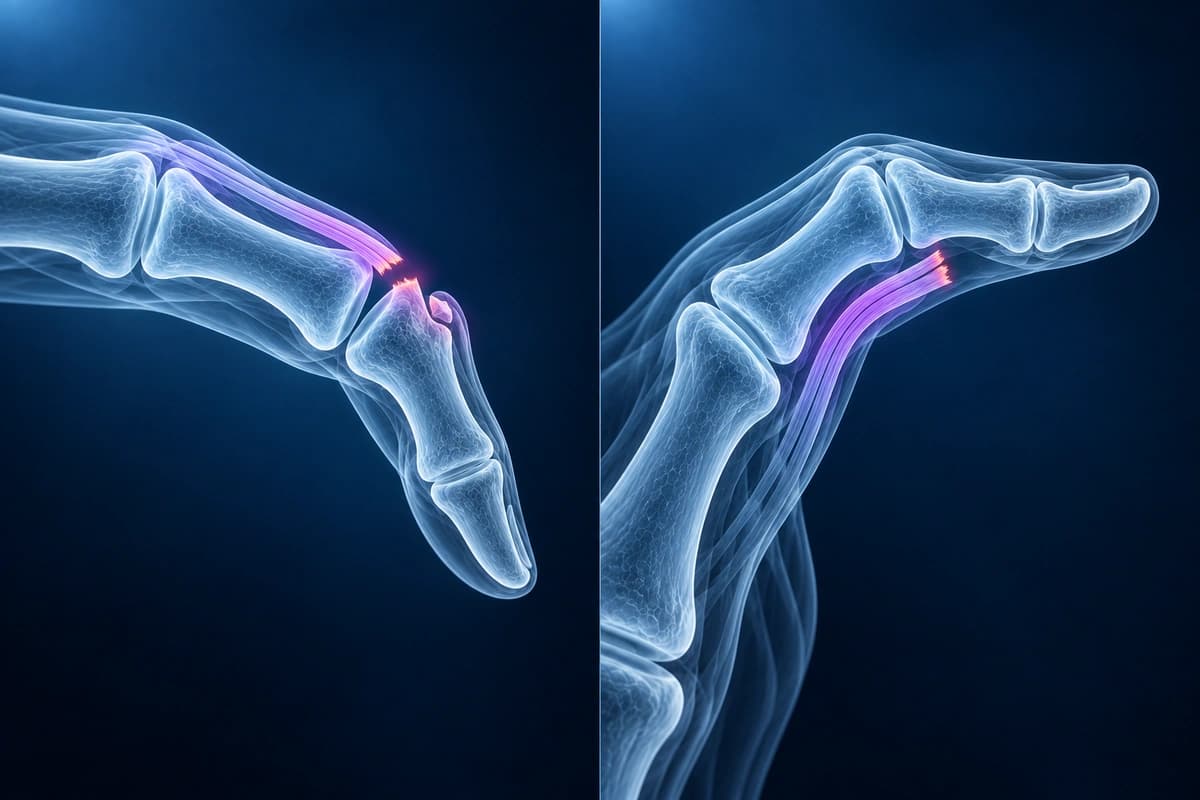
How Imaging Helps
X-rays look for bony avulsion fragments and joint alignment. MRI or ultrasound can directly assess tendon continuity and retraction, especially when the X-ray is normal but the exam shows loss of active motion.
Frequently Asked Questions
Which injury is more urgent?
Jersey finger is often treated as more time-sensitive because the flexor tendon can retract. Mallet finger also deserves prompt assessment, especially with a large bony fragment or DIP subluxation.
Can both injuries happen without a fracture?
Yes. Both can be pure tendon injuries. That is why active fingertip bending and straightening are important parts of the exam, even when X-rays do not show a clear fracture.
Sources
- Leddy JP, Packer JW. Avulsion of the profundus tendon insertion in athletes. J Hand Surg Am. 1977;2(1):66-69.
- Bendre AA, Hartigan BJ, Kalainov DM. Mallet finger. J Am Acad Orthop Surg. 2005;13(5):336-344.
- Lin JD, Strauch RJ. Closed soft tissue extensor mechanism injuries (mallet, boutonniere, and sagittal band). J Hand Surg Am. 2014;39(5):1005-1011.
- Weintraub MD, Hansford BG, Stilwill SE, et al. Avulsion injuries of the hand and wrist. Radiographics. 2020;40(1):163-180.
Related Articles
A plain-language guide to your hand or finger X-ray: how bones and joints should line up, and what fractures, avulsion fragments and arthritis look like.
Learn how X-rays and MRI help separate a jammed finger from a fracture, dislocation, volar plate injury, or tendon injury.
Related Conditions
Understand your imaging before your next appointment
MRI, X-ray or CT from a CD, folder or ZIP. A PDF report or photos of the films work too.
Free to open and preview, no account needed. An optional AI report from $10 explains your images in plain language, with questions for your doctor.
Your raw files stay on this device. Only rendered images and minimal context are sent when you request an AI report.
Medical Disclaimer: This page is for informational and educational purposes only. It does not constitute medical advice, diagnosis, or treatment. AI-generated analysis may contain errors. Always consult a qualified healthcare professional for medical decisions. Full Disclaimer